Shortest Path Visiting all Nodes

You have an undirected, connected graph of n nodes labeled from 0 to n - 1. You are given an array graph where graph[i] is a list of all the nodes connected with node i by an edge.

Return the length of the shortest path that visits every node. You may start and stop at any node, you may revisit nodes multiple times, and you may reuse edges.

Example 1:
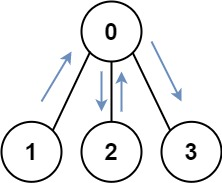
shortest-path-visiting-all-nodes-1.png

Input: graph = [[1,2,3],[0],[0],[0]]
Output: 4
Explanation: One possible path is [1,0,2,0,3]

Example 2:

shortest-path-visiting-all-nodes-1.png

Input: graph = [[1],[0,2,4],[1,3,4],[2],[1,2]]
Output: 4
Explanation: One possible path is [0,1,4,2,3]

1
2
3
4
5
6
7
8
9
10
11
12
13
14
15
16
17
18
19
20
21
22
23
24
25
26
27
28
29
30
31
class Solution {
public int trap(int[] height) {
if (height == null || height.length == 0) {
return 0;
}

int left = 0, right = height.length - 1;
int leftMax = 0, rightMax = 0;
int trappedWater = 0;

while (left < right) {
if (height[left] < height[right]) {
if (height[left] >= leftMax) {
leftMax = height[left];
} else {
trappedWater += leftMax - height[left];
}
left++;
} else {
if (height[right] >= rightMax) {
rightMax = height[right];
} else {
trappedWater += rightMax - height[right];
}
right--;
}
}

return trappedWater;
}
}

双指针方式,空间复杂度O(1),时间复杂度O(n)
每次(x轴单位为1,递进1单位表示作一次比较)比较当前高度和历史最大高度的差形成雨槽。