Design Pattern
设计模式(Design Pattern)是一套被反复使用、多数人知晓的,经过分类编目的、代码设计经验的总结。
设计模式分为三种类型,共23种:
设计模式(Design Pattern)是一套被反复使用、多数人知晓的,经过分类编目的、代码设计经验的总结。
设计模式分为三种类型,共23种:
There are n cities connected by some number of flights. You are given an array flights where flights[i] = [from(i), to(i), price(i)] indicates that there is a flight from city from(i) to city to(i) with cost price(i).
You are also given three integers src, dst, and k, return the cheapest price from src to dst with at most k stops. If there is no such route, return -1.
Example 1:
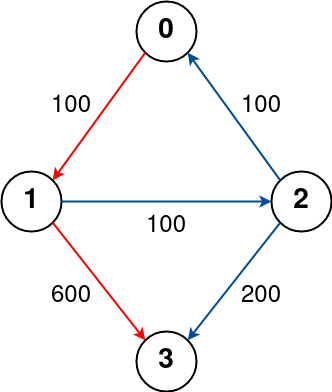
Input: n = 4, flights = [[0,1,100],[1,2,100],[2,0,100],[1,3,600],[2,3,200]], src = 0, dst = 3, k = 1
Output: 700
Explanation:
The graph is shown above.
The optimal path with at most 1 stop from city 0 to 3 is marked in red and has cost 100 + 600 = 700.
Note that the path through cities [0,1,2,3] is cheaper but is invalid because it uses 2 stops.
Example 2:
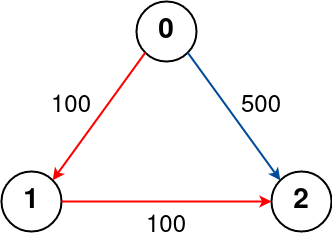
Input: n = 3, flights = [[0,1,100],[1,2,100],[0,2,500]], src = 0, dst = 2, k = 1
Output: 200
Explanation:
The graph is shown above.
The optimal path with at most 1 stop from city 0 to 2 is marked in red and has cost 100 + 100 = 200.
You are given an n x n grid representing a field of cherries, each cell is one of three possible integers.
0 means the cell is empty, so you can pass through.1 means the cell contains a cherry that you can pick up and pass through,or-1 means the cell contains a thorn that blocks your way.Return the maximum number of cherries you can collect by following the rules below:
(0,0) and reaching (n - 1, n - 1) by moving right or down through valid path cells (cells with value 0 or 1).(n - 1, n - 1), returning to (0, 0) by moving left or up through valid path cells.0.(0, 0) and (n - 1, n -1), then no cherries can be collected.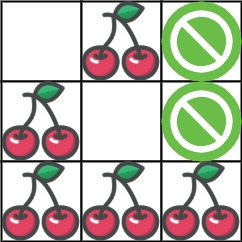
Input: grid = [[0,1,-1],[1,0,-1],[1,1,1]]
Output: 5
Explanation: The player started at (0, 0) and went down, down, right right to reach (2, 2).
4 cherries were picked up during this single trip, and the matrix becomes [[0,1,-1],[0,0,-1],[0,0,0]].
Then, the player went left, up, up, left to return home, picking up one more cherry.
The total number of cherries picked up is 5, and this is the maximum possible.
There is a country of n cities numbered from 0 to n - 1 where all the cities are connected by bi-directional roads. The roads are represented as a 2D integer array edges where edges[i] = [xi, yi, timei] denotes a road between cities xi and yi that takes timei minutes totravel. There may be multiple roads of differing travel times connecting the same two cities, but no road connects a city to itself.
Each time you pass through a city, you must pay a passing fee. This is represented as a 0-indexed integer array passingFees of length n where passingFees[j] is the amount of dollars you must pay when you pass through city j.
In the beginning, you are at city 0 and want to reach city n - 1 in maxTime minutes or less. The cost of your journey is the summation of passing fees for each city that you passed through at some moment of your journey(including the source and destination cities).
Given maxTime, edges, and passingFees, return the minimum cost to complete your journey, or -1 if you cannot complete it within maxTime minutes.
Example 1:
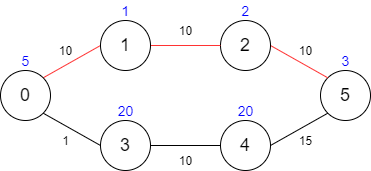
Input: maxTime = 30, edges = [[0,1,10],[1,2,10],[2,5,10],[0,3,1],[3,4,10],[4,5,15]], passingFees = [5,1,2,20,20,3]
Output: 11
Explanation: The path to take is 0 -> 1 -> 2 -> 5, which takes 30 minutes and has $11 worth of passing fees.
Example 2:
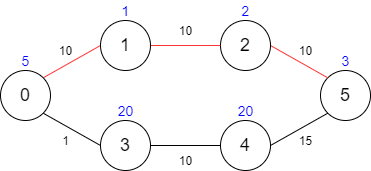
Input: maxTime = 29, edges = [[0,1,10],[1,2,10],[2,5,10],[0,3,1],[3,4,10],[4,5,15]], passingFees = [5,1,2,20,20,3]
Output: 48
Explanation: The path to take is 0 -> 3 -> 4 -> 5, which takes 26 minutes and has $48 worth of passing fees.
You cannot take path 0 -> 1 -> 2 -> 5 since it would take too long.
Example 3:
Input: maxTime = 25, edges = [[0,1,10],[1,2,10],[2,5,10],[0,3,1],[3,4,10],[4,5,15]], passingFees = [5,1,2,20,20,3]
Output: -1
Explanation: There is no way to reach city 5 from city 0 within 25 minutes.
You are given an integer array cookies, where cookies[i] denotes the number of cookies in the ith bag. You are also given an integer k that denotes the number of children to distribute **all*8 the bags of cookies to. All the cookies in the same bag must go to the same child and cannot be split up.
The Unfairness of a distribution is defined as the maximum total cookies obtained by a single child in the destribution.
Return the minimum unfiarness of all distributions.
给你一个整数数组 cookies ,其中 cookies[i] 表示在第 i 个零食包中的饼干数量。另给你一个整数 k 表示等待分发零食包的孩子数量,所有 零食包都需要分发。在同一个零食包中的所有饼干都必须分发给同一个孩子,不能分开。
分发的 不公平程度 定义为单个孩子在分发过程中能够获得饼干的最大总数。
返回所有分发的最小不公平程度。
Example 1:
Input: cookies = [8,15,10,20,8], k = 2
Output: 31
Explanation: One optimal distribution is [8,15,8] and [10,20]
- The 1st child receives [8,15,8] which has a total of 8 + 15 + 8 = 31 cookies.
- The 2nd child receives [10,20] which has a total of 10 + 20 = 30 cookies.
The unfairness of the distribution is max(31,30) = 31.
It can be shown that there is no distribution with an unfairness less than 31.
Example 2:
Input: cookies = [6,1,3,2,2,4,1,2], k = 3
Output: 7
Explanation: One optimal distribution is [6,1], [3,2,2], and [4,1,2]
- The 1st child receives [6,1] which has a total of 6 + 1 = 7 cookies.
- The 2nd child receives [3,2,2] which has a total of 3 + 2 + 2 = 7 cookies.
- The 3rd child receives [4,1,2] which has a total of 4 + 1 + 2 = 7 cookies.
The unfairness of the distribution is max(7,7,7) = 7.
It can be shown that there is no distribution with an unfairness less than 7.